The Words for It
The names are not a glossary. They are one operating architecture, seen from above.

Some sentences get said in every organization. We keep re-litigating this. Everything lives in one person's head. You have to manage up to get anything done. They describe patterns, not any one company's dysfunction, and most leaders can supply the meeting where they last heard one.
What is usually missing is not the experience. It is the handle. A pattern without a name has to be re-described from scratch every time it comes up, and it tends to come up in rooms where there is no time to describe it. A pattern with a name is different. You can point at it. You can define it once. You can send someone the definition instead of the war story.
The writing here has been naming these patterns one piece at a time. Gathered in one place, the names turn out not to be a scattered vocabulary. They belong to one operating architecture, and grouping them shows where each one sits. Read the group headers and you get the shape of what the writing has been building. Read the entries and you get the working vocabulary, each with a link to the piece where the naming happened.
One note on honesty. Some of these are named and defined in the piece they link to. Some are shown clearly but never labeled. A few are working phrases, useful in a room, that were deliberately never turned into sticky terms. Each entry says which it is. If you click through expecting a definition and find a lived scene instead, that gap was the point.
Decision durability: what keeps a decision decided
Most decisions do not fail at the moment of choosing. They fail afterward, when nothing holds them in place and the same conversation comes back around. This group is the machinery that makes a decision stay decided.
Re-decision tax: "We keep re-litigating this. Nothing stays decided." The term is the cost underneath that sentence: the compounding price an organization pays when a decision will not stay closed. It is not paid in the meeting where the argument happens. It is paid downstream, in the hedges and buffers and softened commitments of every function that stopped trusting the plan would hold. Supply chain orders on a 30-day window instead of 90 because the last two long commitments got reopened. That premium is the tax, and nobody books it against the decision that caused it. This is the most load-bearing term on the site; it recurs as a diagnostic across the writing.
Reopen trigger: The fix for the re-decision tax. A pre-committed condition, agreed when the decision is first made, that defines what would earn the right to revisit it. Not "if things change." Specifically: what metric, crossing what threshold, reviewed by whom. Without one, the default trigger to reopen becomes whoever has the most authority or stamina to raise it again, which the piece calls attrition dressed as process.
 Brett W. Farmer
Decision memory: Retrieval, not documentation. A decision that lives in someone's head, or in a slide deck nobody can find, is not really a decision; the piece calls it a rumor with authority. The test is simple: when a decision resurfaces, does the team pull a record or ask a person? If the answer is a name, you have heroes, not a system.
 Brett W. Farmer
Decision boundaries: The line that tells a team what it owns and where it routes. Boundaries are protection, not control. They are the difference between autonomy and drift, because a team that does not know what it is allowed to decide will either freeze or escalate everything.
 Brett W. Farmer
Standards and drift: how the rules quietly stop matching the work
A standard on the wall and the work on the floor start out the same. Over time they separate, and usually nobody decides to separate them. This group is that separation, and how to tell the useful kind from the corrosive kind.
Quiet drift: The gap between how you say you work and how you actually work, widening without anyone choosing it. It does not show up on a dashboard. It shows up when a board member asks a simple question and three regional directors confidently describe three different versions of a process that was signed off eighteen months ago.
Adaptive drift and erosive drift: The distinction that decides your response. Adaptive drift is teams adjusting to real conditions the standard did not anticipate; there is logic under the variation, and it should update the standard. Erosive drift is decay from inattention or turnover; there is no logic, just entropy, and it should reinforce the standard. Treat both the same and you either crush useful innovation or excuse genuine rot.
 Brett W. Farmer
Shadow standard: "We are constantly fighting decisions nobody wrote down." The term names what those decisions add up to: two operating realities running at once. There is the documented system, where lead times are published and planning builds on them, and the practiced system, where commitments flex on relationships and informal knowledge of what operations can actually absorb. It forms one reasonable exception at a time, until planning is building schedules against numbers the field no longer honors.
 Brett W. Farmer
Ownership: who actually holds the thing
The org chart names an owner for everything. The work tells a different story. This group is the distance between the name on the chart and the person who actually carries the weight, and what happens when that person leaves.
Designed ownership versus assigned ownership: "Everyone is accountable on paper, and nobody can break the tie." That sentence is the center of gravity for this whole group. Assigning ownership is easy: a name goes in the R column, a line appears in a RACI. Designing ownership is the actual work: defining what the owner can decide alone, what forces them to act, who checks that they are still exercising it, and what happens when they go. Assigned ownership is faster to stand up and faster to collapse. When it collapses, it usually takes institutional learning with it.
 Brett W. Farmer
Hero memory: "Everything lives in one person's head." Usually said as praise. The term is the risk that phrase is describing: the organizational learning that survives only because one person carries it. Not documented, not role-based, not retrievable by anyone else. It looks like high performance and it is a single point of failure wearing a job title. The tell: the answer to most operational questions in a domain is a person's name instead of a record.
 Brett W. Farmer
Cadence as control: An operating rhythm is a control system, not a calendar. Cadence is a set of decision loops that fire reliably, at the right altitude, with explicit triggers and a clear end state: decisions made and remembered. When it works, teams stop re-litigating the basics. When nobody owns its design, the rhythm keeps firing on schedule long after anyone remembers why, and improvisation is where politics creeps in.
 Brett W. Farmer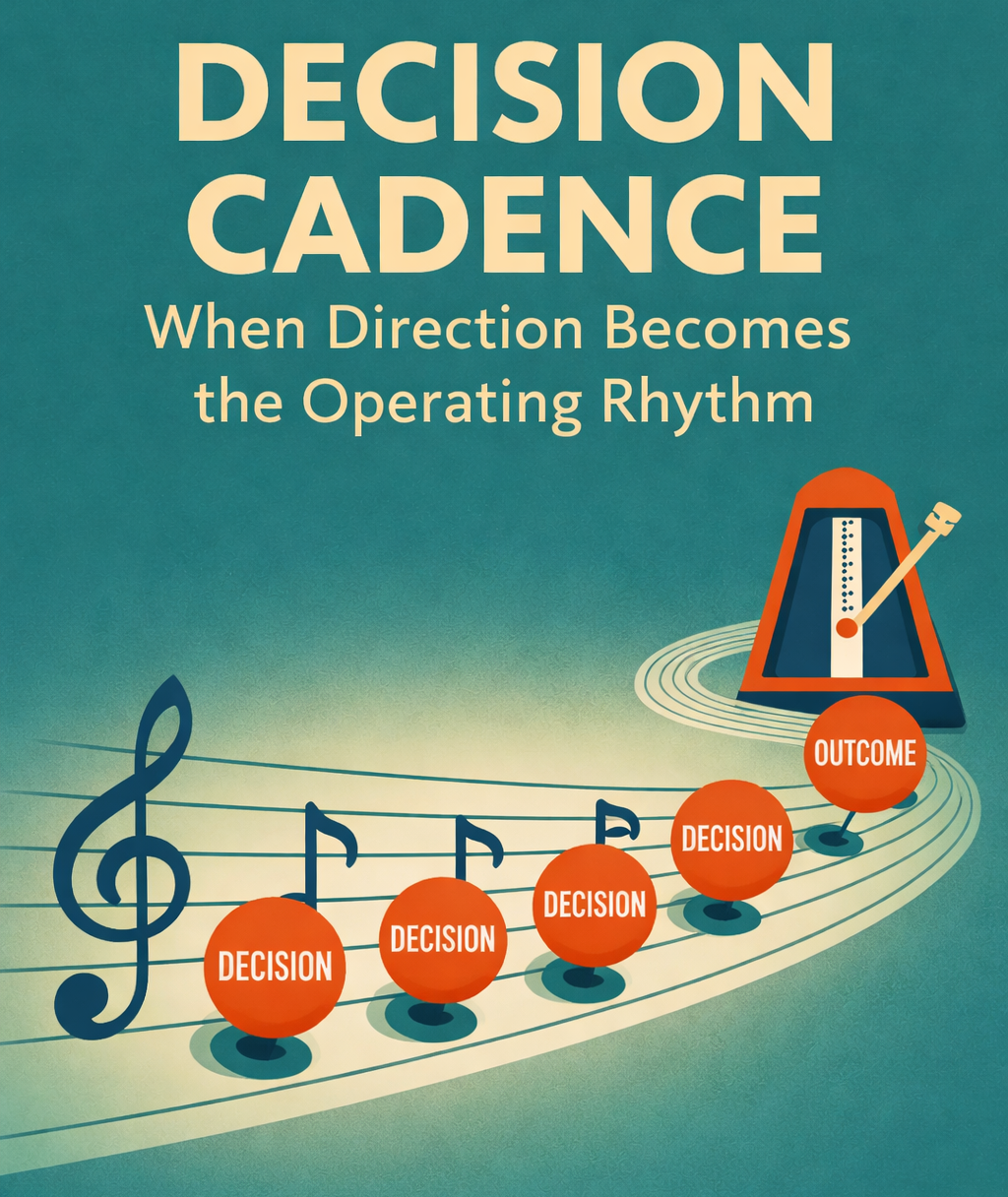
The political layer: friction, and the truth that does not travel
Some of what you inherit is not a process problem. It is people protecting positions, and people managing what they say to survive pressurized rooms. This group is the part of the operating picture that no system records.
The politics of friction: Every cadence protects something, even the broken ones. Some of the friction you inherit is protecting the business and some is protecting a role, and from the outside the two look identical. Strip out the wrong one to look decisive in your first quarter and you take out a load-bearing wall. Until you understand what a given friction is protecting, you cannot know what is safe to change.
 Brett W. Farmer
The polite lie: "You have to manage the ego above you to get what you actually need." The term is what that management costs: the honest version of the status that stops reaching whoever is in charge. It is a trained behavior, not a character flaw: by the time you arrive, the team has already worked out what to say carefully and what to leave unsaid, mostly to keep pressurized rooms running. It is the difference between the status you are told and the status that is true.
 Brett W. Farmer
The number left off the slide: what agreeable artifacts hide
The Architecture That Persuades series traced a single pattern: the document that wins the room by asking nothing of it, and the cost that gets edited out before anyone has to own it. These are working phrases, not formalized terms, and they are grouped here because together they name one discipline. They belong in the same architecture as everything above, because the artifacts are where the operating system goes to get approved.
The sacrifice column: The missing mark on a capability map. Most maps rate everything important and nothing droppable, which documents ambition without cost. The sacrifice column is the paired entry, same row, same weight, that says what you would stop doing to fund this. The moment it exists, "important" stops being free.
 Brett W. Farmer
The second number: The cost a rationalization slide hides. The savings from a decommission get booked as a clean line item; the second number is who actually does the cutting, the teardown work that lands diffusely on whoever inherits it, long after the room moved on.
 Brett W. Farmer
The shared fiction: The locally rational silence around a roadmap nobody fully believes. Everyone can see the date will slip, and naming it means being the one who slowed things down, so the honest roadmap loses to the clean one and the fiction holds until the slip lands by position, not fault.
 Brett W. Farmer
How to read from here
If one of these put a name on something you have been working around, start with its piece. The term is the handle; the piece is the argument behind it. And the next time the sentence gets said in a room, you have something better than a war story. You have a link.
The writing continues, and new names will earn their place in these groups as it does. The architecture was there before any of these had names.