The Standing Charge
The person who keeps saying the true thing ends up holding a bill no one else can see.
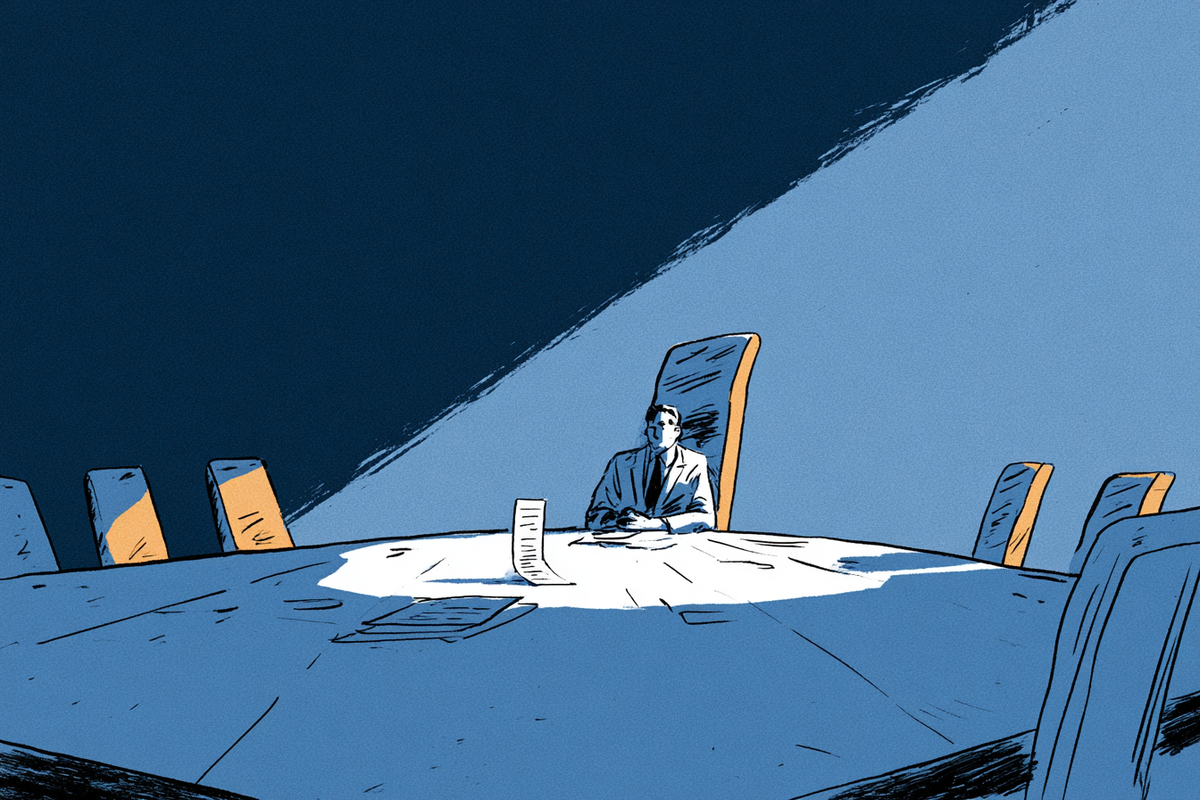
I learned it over lunch. A colleague mentioned it between bites, casually, assuming I already knew.
You know what they call you, right?
I did.
It was nothing cruel. Nobody spits it. It is shorthand, the way busy organizations make shorthand of everyone, and mine translates roughly to: the one who brings problems.
What surprised me was how little it surprised me.
I have spent the better part of twelve years being the person who says the thing the room already knows. The number that will not hold. The date that was never real. The project that is green on the slide and red in the hallway. Someone always knows. Saying it is a different job, and it bills differently.
The bill is easy to miss because no line item on it looks like punishment. A hard question in a review gets aimed at me instead of the person who produced the number, and I answer it, because that is the arrangement. An honest report creates follow-up work that a comfortable report never would, and the follow-up lands on my calendar. A forecast that tells the truth needs twice the proof of one that tells the story, so I build the proof. None of that shows up anywhere as a cost. It reads as diligence. It compounds like debt.
Then there are the parts that never make it onto a calendar. Relationships that cool a degree at a time, with people who did nothing wrong except prefer the problem unsaid. The low hum of being the one, again, in a meeting where everyone else has learned the meeting's real purpose is to end pleasantly. A reputation for negativity, which is what accuracy reads as from far enough away.
There is a fair read where all of this is self-inflicted. Pick softer words. Pick fewer fights. That read is half right, and I will get to the half that is. But softening the sentence does not shrink the number inside it. A missed date does not become less missed because I found a gentler verb. The choice was never between saying it harshly and saying it kindly. The choice was between saying it and joining the silence.
I watched one person refuse that silence completely, for years, with no strategy at all. They were right more often than almost anyone around them, and they said so in every room, at every level, in the same voice. You could watch the arithmetic work on them in real time. Invitations thinned. Their projects drew the scrutiny their honesty had taught everyone to apply. The sponsorship that makes scrutiny survivable never arrived. Nothing dramatic ever happened to them. That is the part worth sitting with. They were not punished for telling the truth. They were slowly rescheduled out of the rooms where the truth mattered, until leaving looked like their own idea.
Nobody in that story is a villain. The room did what rooms do: it priced them. Organizations run on a quiet exchange rate between accuracy and comfort. Most people discover the rate early and adjust. That is why most people stop. Not out of cowardice. Out of arithmetic.
I did not stop. What I changed was aim, and this is the half of the fair read that turned out to be right: not softer words, fewer rooms. Same honesty, chosen moments. The version of me that raised everything everywhere was spending credibility the way a first paycheck gets spent. The version that lasted learned that a true thing said in the right room, at the right time, costs less and moves more. That is not softening. A thing said at full strength, on purpose, where it can land: that is what aim means.
Underneath the aim there is an arrangement I have never written down until now.
I do not think my job is to have the answers. My job is to find people who are better at getting them than I am, and then hold one promise so they can work: they give me the correct answer instead of the easy one, every time, and in exchange, nobody gets to them but through me.
In practice the promise is mostly traffic control. The request to walk through a number that embarrassed somebody lands on my calendar, not theirs. The executive who wants to argue a forecast back down gets a meeting with me. When a review goes badly, my team hears about it afterward, in past tense, with the heat already absorbed and only the work passed on. Questions come to me. Heat comes to me. The hard review, the follow-up, the proof-building, the defense of an honest number to someone who wanted a different one: mine.
If there is a problem, it starts with me.
None of this makes me the one who speaks for them. My team presents their own work, defends their own methods, and takes their own questions, in every room that is about the work. The rooms that route through me are the ones that are about blame. A team gets better in the first kind of room. Nobody gets better in the second.
Their side of the deal is just as plain. I get the real number the day it exists. Not the version with the edges sanded. Not the week it can no longer be hidden.
No one signs this arrangement. It renews on evidence. The deal extends each time the team watches a hard review happen and none of it rolls downhill. The balance grows when an honest number gets defended instead of quietly traded away. It would take exactly one forwarded consequence to break it, and everyone involved knows that, including me.
That is the whole reason the bill keeps coming back to my desk. I route it there. A team that watches its leader absorb the cost of telling the truth learns that the truth is affordable. A team that watches its leader forward that cost learns the exchange rate like everyone else, and starts producing comfort. I know which team I want to lead. So I know where the bill has to land.
And the return on the arrangement does not look like loyalty or morale, though it gets called both. It looks like a Tuesday. Someone is at my door with a number that ruins my week, and they are there the day they found it. Nobody upstream asked for it. Nobody softened it first. It arrived at full strength while there was still time to do something about it, because the person carrying it had no math to do at my threshold. Bad news travels to me at the speed it travels between people who trust each other. That is the only speed at which bad news is still useful.
The exhaustion is real, and the label does not wash off. But I have sat with teams where the true things arrived a quarter late and half the size, and I know what that lateness costs. Decisions get made on numbers that were already fiction when the meeting started. Fix windows close while the problem is still being phrased carefully. By the time the truth is safe enough to say, it is too old to act on. I have also sat with teams I have led. The difference is not close.
The lunch where I learned my shorthand ended like most lunches. We paid and went back to work. The name a room gives you is just the receipt. It shows what you have been paying for all along. I have read mine. I would run the charge again.