From Service Delivery to Transformation Leadership
Across the Divide Series
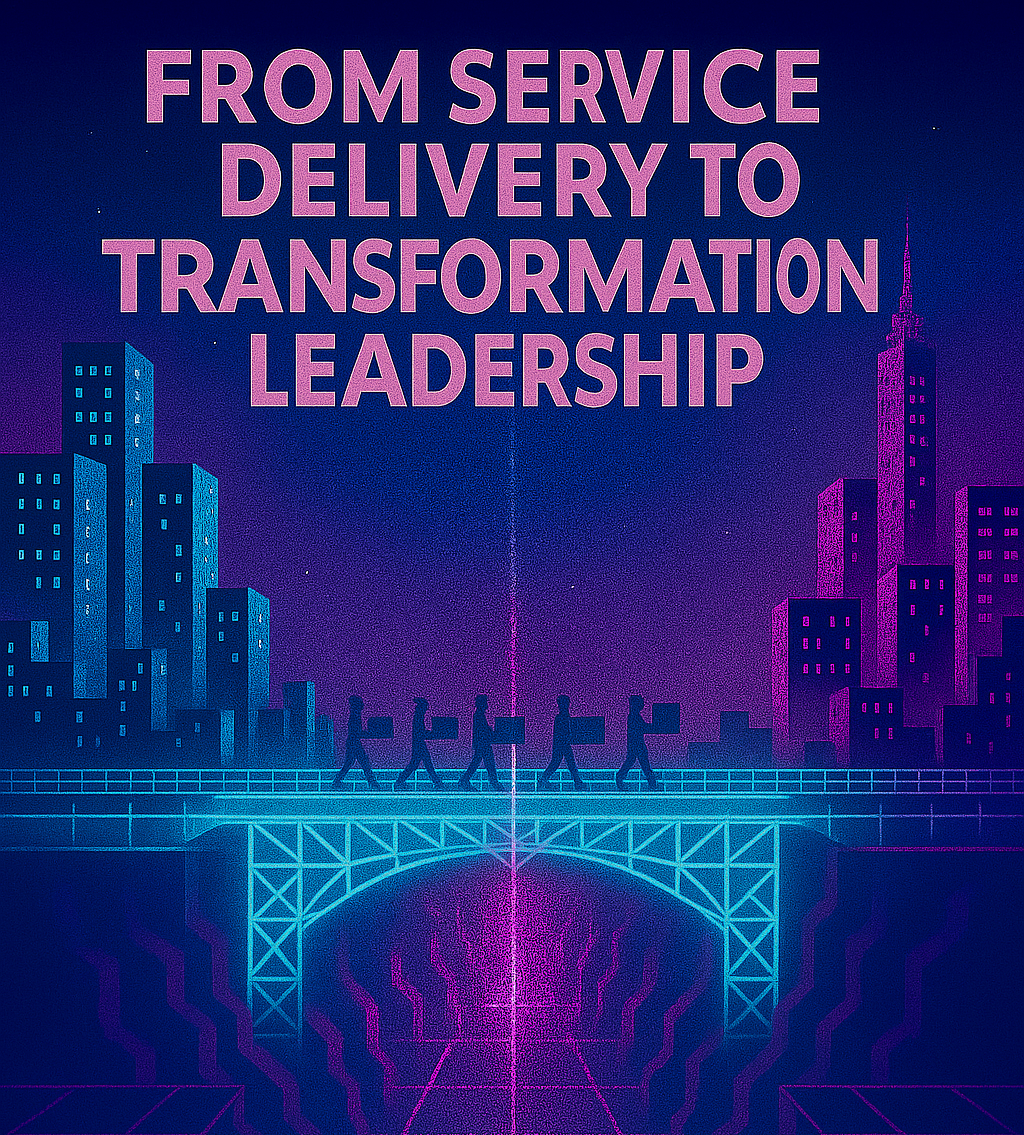
Before I could say I ever led a transformation program, I led and was active in service delivery.
The kind where every minute mattered and where your name showed up in meetings or on the report when it didn't get fixed fast enough.
I didn’t start in some sleek, corporate office. I started in local government. I supported public safety, utilities, finance, public works. Real people, real consequences. When the network went down, payroll stopped. When dispatch screens froze, response times slipped, lives were on the line.
There’s no “low priority” when the work you support literally keeps the lights on.
That’s where I learned that service isn’t a department. It’s a mindset.
Those early years wired me. They shaped how I think about accountability, leadership, and what transformation really takes and how real people are left to make things work.
Service as Survival
In local government IT, “essential” takes on a whole new meaning.
Every call had a story. A missed deadline. A frustrated employee. A citizen waiting. You learned to listen more than you spoke, because you were fixing more than a ticket.
You were restoring someone’s ability to serve their community.
That job taught me humility.
It taught me that process isn’t bureaucracy; it’s how you make sure the same mistake doesn’t happen twice.
It taught me that documentation isn’t just paperwork or a form to be approved. It’s how you make invisible work visible to others.
And it taught me that technology, at its best, is an act of service.
The Year in Telecom
My time in telecommunications took that lesson and turned up the volume.
Suddenly, scale was the challenge. Thousands of endpoints, regional data centers, satellites, and service-level agreements measured in minutes, not hours. You learned to breathe through the chaos; to troubleshoot under pressure and communicate clearly when others were spiraling.
I remember outages where all the best laid plans and runbooks couldn't solve the issues.
No one cared how complex the root cause was; they cared that their service was down and someone was owning the problem.
It was the mission.
Those experiences taught me that discipline under pressure is its own kind of leadership. It’s what separates teams that recover from those that collapse.
Telecom drilled that into me: service is operational muscle memory.
And that muscle is exactly what digital transformation demands today.
Because transformation, done right, isn’t simply innovation; it’s reliability. It’s the same backbone that keeps networks stable now applied to how organizations evolve. McKinsey & Company (2024) calls this the “architecture of execution.” Without it, companies chase new tools but never reach new results.
I’ve lived that. The flashiest technology means nothing if your culture panics the moment it breaks.
The Bridge Between Service and Strategy
When I was knee-deep in outage reports and escalation calls, I didn’t see it as strategy. I just saw it as survival. But years later, when I was given the opportunity to stand up enterprise transformation programs, I realized that every habit from those service years became the foundation for leading change.
Clear ownership. Repeatable processes. Real-time communication.
That’s not project management jargon. That’s service DNA.
It’s also the only way transformation lasts. Because digital change doesn’t crumble from a lack of ideas.
It crumbles when the small, operational details get ignored.
Every “big picture” strategy eventually runs into someone’s daily reality.
And if those people don’t trust the process, the data, or the leadership behind it, the strategy doesn’t stand a chance.
What Service Teaches You About Empathy
Empathy gets tossed around like a buzzword. But in service delivery, it’s not optional.
It’s 2 a.m. and the city’s payroll system just failed. You can hear the exhaustion in someone’s voice. You realize technology is deeply human, behind the scenes. It’s someone’s paycheck, someone’s safety, someone’s reputation.
That kind of empathy stays with you. It changes how you lead.
When I’m driving a transformation today, I don’t talk about “user adoption” like it’s a KPI that needs tracked....
Adoption is confidence. People adopt what they trust. They trust what works. And they trust the people who show up when it doesn’t.
That’s not soft stuff. That’s leadership.
Gulati and Noor (2023) put it best: frictionless organizations aren’t built by removing effort; they’re built by building trust through reliability. Service delivery taught me that long before I read it in a book.
From Provider to Partner
Telecom also gave me a front-row seat to what real partnership looks like.
When a client’s operation was on the line, partnership wasn’t a slogan—it was staying calm in the chaos. They didn’t remember every report we sent or every SLA we met. They remembered who called first, who communicated honestly, and who didn’t disappear when things got messy.
That stuck with me.
Now, when I work with vendors or internal partners on transformation, I look for that same DNA. I don’t care about polished decks or buzzwords. I care about people who own the outcome like it’s theirs.
Partnership isn’t shared branding—it’s shared accountability.
And the best partners I’ve seen carry that same service instinct: steady, transparent, allergic to blame.
Lessons That Still Guide Me
There are three lessons from those service years that I carry into every transformation:
Clarity before speed.
In service work, moving fast without understanding the problem makes things worse.
It's the same in transformation. Diagnose before you deploy.
Communication over perfection.
Customers will forgive downtime faster than they will forgive silence.
Transparency builds more trust than a flawless system ever could.
Consitency builds confidence.
Reliability compounds. The small, predictable wins make big change believable.
These just aren’t technology lessons; they’re leadership lessons.
They remind me that transformation doesn’t need more tools; it needs steadier hands.
Seeing the Whole Picture
Looking back, those years in local government and telecom weren’t detours. They were unplanned preparation.
I didn't know that what was waiting for me at the end of those experiences were lessons that I will carry with me my entire career.
Telecom taught me precision. How to deliver it (service) at scale.
And transformation leadership is teaching me perspective; and how we turn that discipline into momentum.
Each step built on the last. Somewhere along the way, I realized that the best transformation leaders aren’t visionaries shouting from the whiteboard—they’re operators who never lost their sense of service.
They know that strategy without delivery is theater, and delivery without empathy is machinery.
Real transformation lives between the two.
Across the Divide
I often talk about digital transformation as building bridges: between silos, systems, and people. But the most important bridge I ever built was between service and strategy.
Because the leaders who’ve lived both sides: who’ve answered the 2 a.m. call when things broke and later designed the systems to prevent it—carry a perspective you can’t teach.
They know that transformation isn’t about being the smartest person in the room. It’s about being the most reliable.
Technology fades. Tools change. Priorities shift.
But reliability, empathy, and ownership never go out of style.
If transformation really is about creating lasting change, maybe it starts where mine did: in the service bay, on the help desk, in the middle of the night when something breaks and someone decides to make it better.
That’s the real foundation of transformation.
That’s the human side of progress.
And that’s how you bridge the divide.
References
Christensen, C. M. (2016). Competing against luck: The story of innovation and customer choice. Harper Business.
Gulati, R., & Noor, M. T. (2023). The frictionless organization: Deliver great customer experiences with less effort.Harper Business.
McKinsey & Company. (2024). The State of Organizations 2024: Ten shifts transforming organizations. McKinsey & Company.