Decision Trust: When Leaders Actually Believe the Numbers
Decision Design creates the decision moment. Decision Trust determines whether anyone will act inside it.
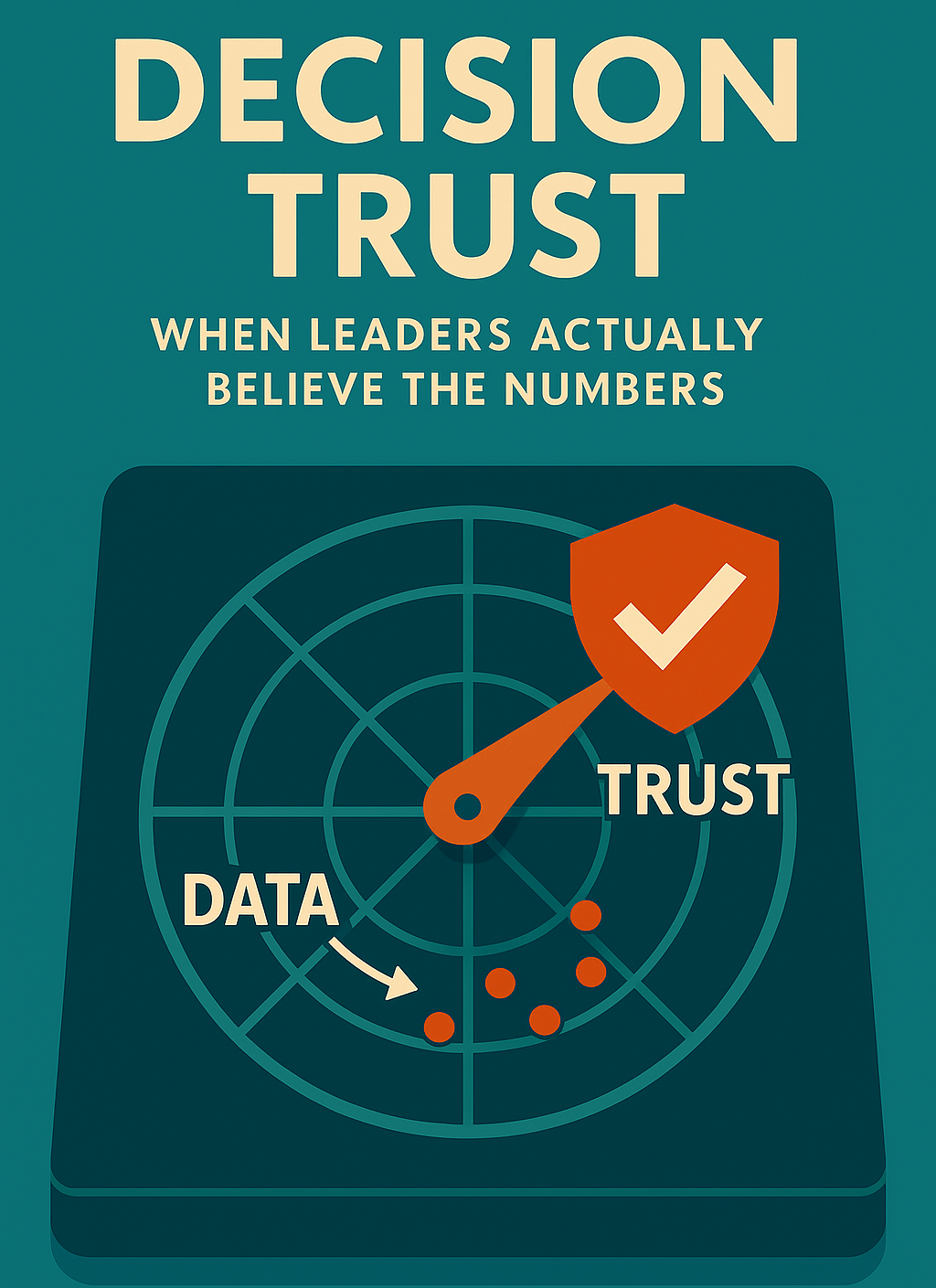
I keep thinking about something we said in our Decision Design chapter, and I didn’t realize how incomplete it was until I watched a leadership team hesitate in front of a perfectly good number.
A dashboard isn’t a decision. It’s an invitation. Decision Design turns that invitation into a repeatable moment: a loop, a cadence, a set of questions and owners and triggers that keeps the organization from staring at the data and walking away unchanged. But here’s the part that doesn’t show up in the playbooks. Decision Design creates the decision moment. Decision Trust determines whether anyone will act inside it.
I can still picture the room where that clicked for me. Long table. Forecast review on the screen. Numbers lined up clean and tidy, the way they always are right before they get tested. Finance walked us through revenue, margins, the usual comparisons. Everyone nodded at the right moments. Questions came in, polite and safe.
Then the meeting hit its real moment, the one nobody writes down. An executive leaned back and said, almost casually, “This looks good. I’m going to have my team rerun it just to be sure.”
Nobody flinched. Nobody challenged it. The report was final. The team had done the work. The logic had been reviewed. The presentation was polished. And still, the first instinct was a rerun. That’s when I realized we weren’t dealing with reporting. We were dealing with the condition that determines whether reporting can ever become decision making.
Here’s the cleanest definition I’ve found: Decision Trust is the degree to which people are willing to act on a number without rebuilding it. You can hear it in the first question that shows up in the room. In low-trust environments, the first move is verification. “Are we sure this is right?” In higher-trust environments, the first move is commitment. “Given this is our reality, what are we going to do?” Same dashboard. Completely different posture.
This is why teams can do honest, technically competent work and still feel stuck. They improve pipelines. Align definitions. Add governance. Document lineage. They build what everyone says they want. And still, the meeting ends in reruns. That instinct is rarely about being difficult. It’s usually about history. People are responding to the last time they trusted too fast and got surprised at the worst possible moment.
So the room builds armor. Quietly. Rationally. The second monitor with a private spreadsheet open. The analyst asked to pull raw data one more time. Screenshots passed around like evidence. Nobody has to say “I don’t trust this.” The behavior covers it.
If trust is the constraint, the next question is simple: where does it leak out? Most organizations treat trust like one vague thing and try to solve it with more tooling. But Decision Trust leaks through a few predictable seams, and each seam requires a different repair.
Sometimes the leak is technical. Data arrives late. Refresh timing drifts. Two tools show different values for the same metric. Filters produce surprises because the logic is buried somewhere nobody can explain in plain language. Painful, but legible.
Sometimes the leak is semantic. People use the same word for different realities. Revenue, bookings, shipments, margin. A meeting burns twenty minutes and someone finally says, “We’re actually looking at two different numbers.” That moment doesn’t just waste time. It teaches the room that language isn’t stable, so decisions can’t be either.
And sometimes the leak is social. Surprise metrics dropped into exec decks. Numbers used to corner a function in public. Leaders cherry-picking slices that support a story they already wanted to tell. People learn quickly whether data is being used to clarify reality or to win a moment. If it’s the second, trust drains away even when the pipeline is technically perfect.
So here’s the structure underneath it, and it’s worth being blunt.
Technical trust is necessary. Semantic trust makes the conversation coherent. Social trust determines whether anyone will risk commitment.
Decision Trust is what you get when all three hold long enough that the number stops being treated like a suspect and starts being treated like a baseline.
That’s the hinge, because this is the moment Decision Design either becomes real or stays theoretical. If the number is a suspect, the loop collapses into validation rituals. If the number is a baseline, the loop turns into tradeoffs. And you can’t announce your way into that hinge. Trust isn’t a policy. It’s a pattern, earned in repeated moments where the number holds and the meeting stays safe enough for people to act.
So how do you build it without turning the next year into a governance campaign everyone tolerates and nobody absorbs? You do what we did with Decision Design.
You start with one real decision moment, not a broad program. Pick one report that matters, the one that shows up in executive rooms and carries real weight in budget, operations, headcount, or customer commitments.
Then run a short pulse, not as a survey project but as a mirror. Can you act on this without rebuilding it? How often has it contradicted other “official” numbers recently? When it shows a clear signal, does a decision follow in an agreed timeframe, or does the room drift into reruns? What single change would increase your willingness to move on it?
The point isn’t to score people. It’s to locate the crack. Once you know what kind of crack you have, the next move becomes practical instead of political. Drift and reconciliation are technical. Competing definitions are semantic. Surprise and blame are social. All three are solvable. None of them are solved by pretending they aren’t there.
One more truth, the one leaders resist because it forces prioritization. You can’t fix all of it at once. So treat it like a pulse. One report. One quarter. One measurable lift in Decision Trust. Make one repair that matches the seam, then prove it in the room. Tighten lineage and refresh discipline. Settle the definitions that matter. Stop surprising leaders with numbers they’ve never seen before and model that quality questions are welcome early, never weaponized late.
That last one sounds soft until you see what it actually does.
When people believe they won’t be punished for surfacing uncertainty early, the whole system stabilizes. The shadow system starts to die off, not because you ordered it to, but because people don’t need it as armor anymore.
This is what Decision Trust looks like when it starts to take hold: fewer reruns and fewer parallel rebuilds, more decisions made in the meeting instead of three days later, more debate focused on tradeoffs, not audits. The room stops interrogating the number and starts responding to it.
And that’s where capacity comes back. I’ve felt it personally. Early in my career, I rebuilt numbers out of habit. It felt safer to spend extra time validating than to risk being caught flat-footed later. Over time, in teams where we did the slow work on governance, definitions, and meeting behavior, that habit loosened. Not because I became less critical, but because the system earned the right to be trusted. That shift frees energy. Instead of living in spreadsheet archaeology, you get to live in implication. Instead of fixing the report, you get to ask, “Given this, what are we going to do?”
That’s what Decision Trust buys you. Not perfection. Capacity to move faster without pretending you know more than you do. Capacity to focus debate on strategy instead of validation rituals. Capacity to have bolder conversations because the floor under them feels solid.
So this chapter really is the sequel to Decision Design. Decision Design creates the repeatable decision moment. Decision Trust determines whether anyone will step into that moment when the stakes are real. And if you want the simplest field test of where you stand, it’s the one we started with. When the numbers come up, does the room move into tradeoffs, or does it move into reruns?
If you measured Decision Trust on just one report in your organization, what would you find?
Sources
Davenport, T. H., & Harris, J. G. (2007). Competing on analytics: The new science of winning. Harvard Business School Press.
Luca, M., & Edmondson, A. C. (2024). Where data-driven decision-making can go wrong. Harvard Business Review, 102(5), 80–89.
McAfee, A., & Brynjolfsson, E. (2012). Big data: The management revolution. Harvard Business Review, 90(10), 60–68.
McKinsey & Company. (2022, January 28). The data-driven enterprise of 2025. McKinsey Analytics.