Decision Direction: When Data Leads to Clarity
Trust removes the argument. Decision direction removes the drift.
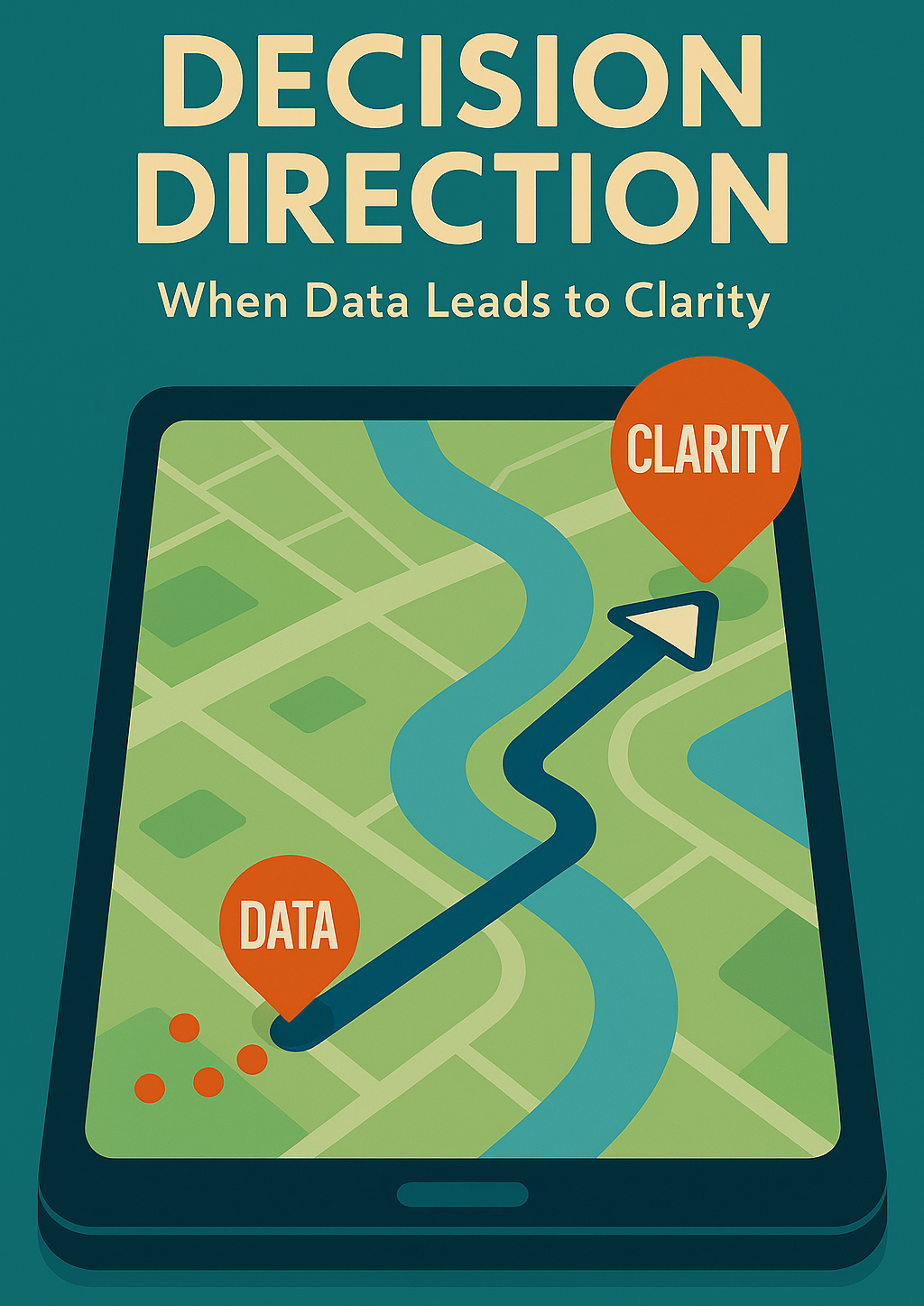
Remember that meeting?
The meeting always starts the same way. A screen. A familiar deck. The same charts everyone’s learned to nod at. But this time the underlying work is actually holding. The numbers are clean. The definitions line up. Nobody is arguing about which report is “right.” You can feel the calm settle in. And still, the team doesn’t move. Not because they don’t trust the numbers.
They do. They just don’t know what the numbers want them to do.
That’s the step after Decision Design and Decision Trust. It’s not more dashboards. It’s not more belief. It’s direction.
Here’s the thesis: direction happens when trusted data is paired with explicit decision rights, clear thresholds, and a cadence that forces choices. If trust is “I believe the number,” direction is “I know what we’re doing next, and I can do it without drama.” Another way to say it, more bluntly: direction is clarity with authority attached. Most organizations stop at trust and call it maturity. Then they wonder why the reviews feel productive but the outcomes barely shift. Trust removes the argument. Direction removes the drift.
You can see the drift in places where the data is already good enough. Scrap creeps up. The chart is clear. The trend is real. Everyone believes it. But nobody wants to be the one to say, “We’re stopping the line and resetting the process.” So the conversation slides into hypotheses, small tasks, and polite patience. Or conversion drops. Nobody debates the metric. The debate becomes ownership. Marketing, sales, pricing, customer experience. Everyone can be right at once, which means nobody has to be accountable today. When trust is high but direction is low, the organization becomes politely indecisive. It starts to look like sophistication. It’s not. It’s avoidance with better charts.
The temptation at this point is to blame the data anyway. “If we had just one more integration.” “If we improved this model.” “If we cleaned up the last few definitions.” Those things matter, but they’re often not the real blocker.
Direction usually fails at three seams, and none of them are solved by another dashboard. (This will start to sound really familiar if you are playing along at home...)
The technical seam is simple: does the signal arrive in time and reliably enough to be acted on, not debated? If the number shows up late, if it’s fragile, if it needs a human to reconcile it every time, the organization will treat it like history, not guidance.
The semantic seam is just as unforgiving: do people mean the same thing when they say “customer,” “on time,” “yield,” “forecast,” “margin”? Direction dies in semantic fog because decisions cannot survive ambiguity at the moment of action.
And the social seam is the one leaders often feel but rarely name: who is authorized to decide, who carries the risk when a bet doesn’t pay off, and who wins when decisions stay vague? Decision Trust stabilizes belief in the number. Decision Direction demands a harder question: what does this metric authorize us to do?
As you know, most companies have metrics.
Fewer have authorizations.
That’s the real difference between a system that reflects and a system that moves. A metric becomes a lever when it has a defined response: if it’s here, we do this; if it crosses that line, we escalate; if it stays within range, the local owner acts without asking permission. That’s not rigidity. That’s leadership doing its job. A simple litmus test: when a metric moves materially, can the team act inside one meeting without needing to go find permission somewhere else? If the answer is no, you don’t have direction. You have reporting.
This is where it helps to ground the idea in one decision, not a theory. Take forecast accuracy.
In a lot of organizations, forecast error is treated like a scoreboard. Everyone looks at it, everyone agrees it’s not great, and then everyone moves on. A lever looks different. If the error band stays within tolerance, the planning lead adjusts next week’s build and logs the assumption. If the error breaks the threshold two cycles in a row, it triggers a cross-functional review and a containment action, not a debate. Maybe that action is tightening allocation rules, freezing late changes, or pulling a specific product family out for a deeper demand review. Same metric, totally different system. One reflects. The other moves. That’s decision direction in practice: the number isn’t just telling a story. It’s authorizing a response.
Cadence is the part leaders underestimate because it smells like process. But cadence is how direction becomes normal instead of heroic. Cadence is where intent turns into behavior. Without cadence, direction depends on mood and personality. With cadence, it becomes a property of the system. Without it, you get one-off acts of decisiveness surrounded by weeks of drift.
A good cadence forces prioritization, because not every KPI gets to be a steering wheel. If everything is critical, nothing is steerable. It forces memory, because a decision log ties what we saw to what we chose, what we assumed, and what happened next. Not for audit theater, but for organizational learning.
Teams that don’t log decisions end up re-litigating the same questions every month, with slightly different slides and the same underlying uncertainty. And cadence forces escalation paths, so the system admits early when something is bigger than one team. Not every issue belongs at the top, but every issue needs an owner and a clear route when it crosses a line. Without that, you don’t get direction. You get recurring debates and late surprises.
This is also why AI and automation raise the stakes. They’re accelerants. They don’t tolerate fuzzy ownership. They don’t correct for political hesitation. They don’t understand that your organization carries three competing definitions of “customer.” And if your definitions are inconsistent, automation doesn’t average that out. It operationalizes it.
If “customer” means three different things, your automations will trigger three different interventions, and you’ll call it “model drift” when it’s really definition drift. That’s the socio-technical truth leaders keep relearning: a technically sound model can still drive bad outcomes if the decision system around it is weak. Clean data can still lead nowhere if authority is unclear. Beautiful dashboards can still get ignored if incentives punish action. In other words, the technology can be ready while the organization is not.
So what does Decision Direction look like when it’s real?
It looks like fewer metrics, sharper ones, and each has a purpose: steer, monitor, diagnose. Thresholds stop being vibes and start being operational tolerances tied to real outcomes. Decision rights are written in plain language: if X happens, Y decides, by Z time, using A and B inputs. Meetings end in decisions, not observations. “Here’s what we saw” becomes “here’s what we’re doing,” with a timestamp, an owner, and a follow-up date. Decision logs are treated like working assets, not a binder, so you can see patterns over time: where you escalate too late, where you overreact to noise, where you keep making the same assumption and keep being wrong.
And it looks like reinforcement, because most transformations fail right here. Leaders say they want people to act on data. Then the first time someone acts and the outcome is messy, they get punished for decisiveness instead of coached for learning. The organization absorbs the lesson quickly: it’s safer to analyze than to decide. Direction cannot survive that. If you want decision direction, you have to reward responsible action even when the result is imperfect, and you have to separate decision quality from outcome quality long enough for learning to stick. That’s not soft leadership. It’s mature leadership. It’s also the only way you build an organization that can move faster than the complexity around it.
There’s one more tension worth naming because it’s where good leaders can accidentally sabotage themselves.
Direction feels like it should be centralized. One compass. One North Star. One set of priorities, tightly controlled. But direction that scales is centralized intent and distributed action.
Leaders set boundaries, definitions, priorities, and escalation rules. Local teams move fast inside those boundaries. Centralize every call and you slow down. Distribute without intent and you drift. This is the craft: you’re not just designing metrics, you’re designing autonomy. And autonomy in a data-rich environment has a price. The price: clarity.
Clarity about what matters most. Clarity about what decisions look like. Clarity about who owns what. Clarity about what happens when you’re wrong, and how quickly you correct.
It’s tempting to treat direction as something you get after you finish governance, finish integration, finish standardization. In practice, direction is what makes those efforts worth funding, because direction is the part the business can feel. A cleaner semantic layer is invisible until it stops meetings from becoming arguments. Better integration is invisible until it cuts response time from days to minutes. Higher trust is invisible until a team takes action with confidence instead of waiting for perfect certainty. Decision Direction is the moment the organization stops admiring the instruments and starts flying the plane.
If you want to start without turning this into a six-month program, harden one repeating decision.
1. Pick something that matters and recurs.
Could be production scheduling, forecast adjustments, inventory reorders, credit holds, pricing exceptions, quality containment.
2. Write five things down, with real names and real thresholds.
What signal triggers the decision, what threshold forces action, who decides inside the normal range, when it escalates and to whom, and how the decision will be logged and reviewed.
Do that once and the whole system reveals itself. The seams show up fast. That’s the point.
Decision Direction isn’t about more content, more dashboards, more meetings. It’s about building a decision system that makes clarity possible when it matters.
One last quiet truth: clarity is not certainty.
Clarity is commitment with eyes open. Direction is an organization choosing to move, knowing it may have to correct course, and having the discipline to learn quickly when it does.
Field test for this week: Where are you still explaining last week instead of choosing next week?
Sources
Davenport, T. H. (2006). Competing on analytics. Harvard Business Review, 84(1), 98–107, 134.
Klein, G. A. (1999). Sources of power: How people make decisions. MIT Press.
National Institute of Standards and Technology. (2023). Artificial intelligence risk management framework (AI RMF 1.0) (NIST AI 100-1). https://doi.org/10.6028/NIST.AI.100-1
National Institute of Standards and Technology. (2024). Artificial intelligence risk management framework: Generative AI profile (NIST.AI.600-1). https://nvlpubs.nist.gov/nistpubs/ai/NIST.AI.600-1.pdf
Weill, P., & Ross, J. W. (2004). IT governance: How top performers manage IT decision rights for superior results. Harvard Business School Press.