Decision Cadence: When Direction Becomes the Operating Rhythm
Clean dashboards don’t create movement. Decision cadence does.
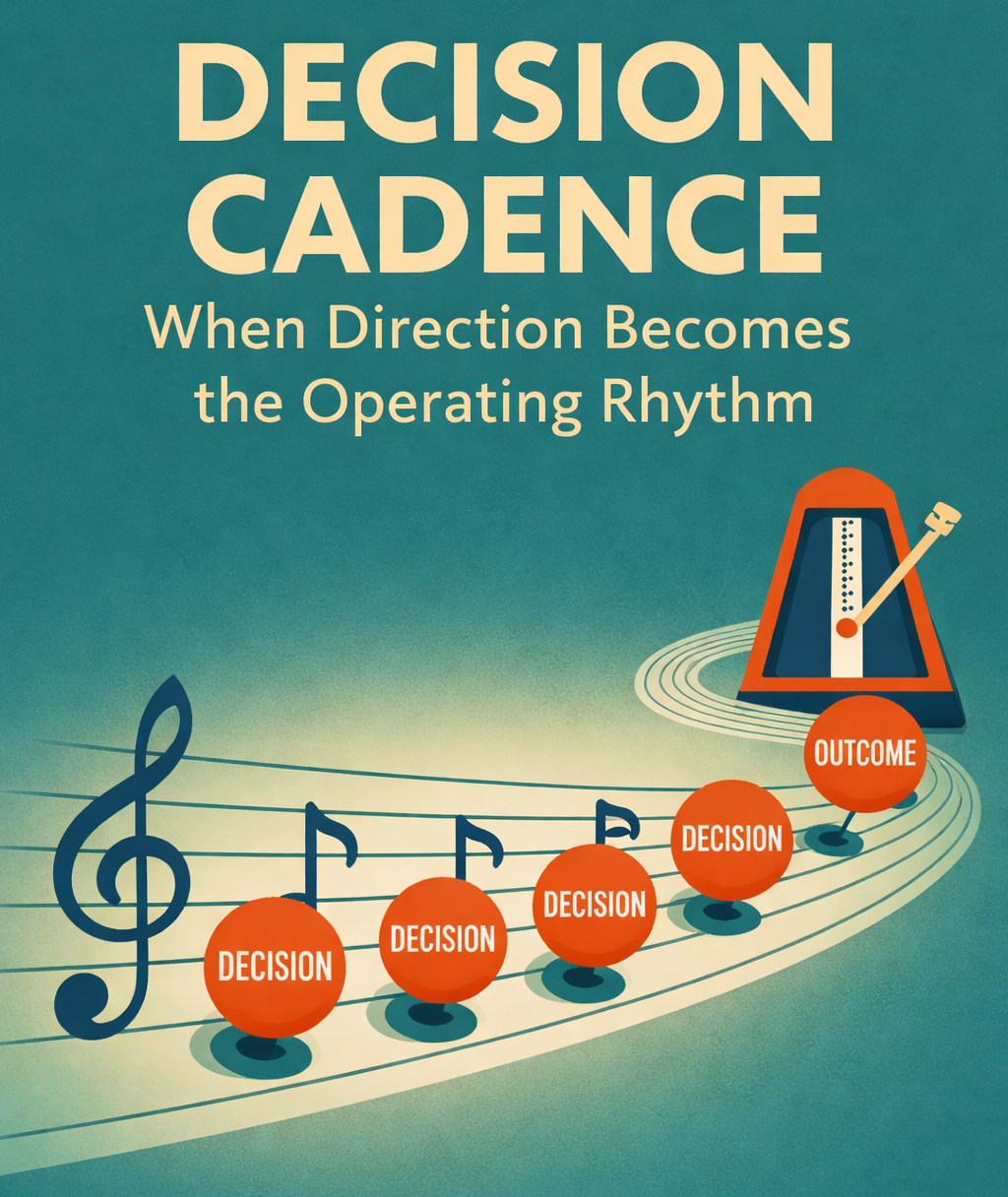
I keep coming back to a familiar moment. A team finally gets the foundation right. Definitions align. Dashboards stop contradicting each other. Meetings get calmer because people aren’t burning time debating whose report is “correct.” You can feel the relief in the room.
And then the week shows up.
A metric swings hard and no one’s sure if it’s signal or noise. A customer escalates. A delivery date slips. A system hiccups at the worst possible time. Someone asks for one more cut of the data before committing. The room gets loud again, not because the data is broken, but because clarity is fragile when it’s held together by attention instead of habit.
Direction is the moment you can say, “Here’s the call.” Cadence is what makes that call repeatable. If direction only exists when the right people are in the room, focused and fully present, you don’t have direction. You have a meeting artifact.
Most organizations don’t stall because they lack intelligence or care. They stall because they haven’t built a decision rhythm sturdy enough to carry clarity through the week you’re actually having.
Here’s the pattern that plays out almost everywhere. First, you build data trust. You standardize definitions. You close obvious gaps. You reduce contradictions. You reach the point where people can say, “I believe what I’m seeing.” Then you build direction. You clarify decision rights. You name thresholds. You translate “interesting trend” into “we will do X by Friday.”
Then the slide happens. Not because the work wasn’t real. Because the next step is not more trust or more direction. The next step is cadence.
Without cadence, direction decays back into discussion. When pressure rises, people reach for what feels safe: more analysis, more inputs, more meetings, another report, another view. The intention is usually good. Reduce risk. Avoid mistakes. Be thorough. But when the system doesn’t convert signal into action, the organization starts confusing motion with progress. You get better and better at explaining, and still struggle to change what happens next.
This is where leaders get tripped up. We’re taught that cadence equals bureaucracy, that it slows you down, that it creates overhead and kills flexibility. In practice, the right cadence does the opposite. It creates speed because it reduces negotiation overhead. It reduces the cognitive load of figuring out who decides, when, with what information, and under what constraints. It also reduces a quieter tax: the emotional drain of replaying the same debate every week like it’s brand new.
Cadence is how decisions survive Tuesday. Not as a slogan. As an operating reality. When inboxes are on fire and priorities collide, cadence prevents the organization from improvising decision rules in the moment. That improvisation is where politics creeps in. It’s where the loudest voice wins. It’s where teams stop trusting the process because the process keeps changing depending on who’s in the room.
So let’s get crisp about what cadence is.
Cadence is not “more meetings.” Cadence is a set of decision loops that fire reliably, at the right altitude, with the right triggers, with a clear end state: decisions made and remembered. When cadence works, teams show up ready to decide because the inputs are stable, the thresholds are explicit, and the decision rights are real. They don’t re-litigate the basics. They don’t mistake visibility for progress. They move.
Here’s a scene that might feel uncomfortably familiar. It’s a weekly performance review. The dashboard looks clean. Everyone agrees the churn number is real. The group spends twenty minutes explaining why churn went up: pricing pressure, competitor moves, product gaps, support wait times. Everyone has a piece of the story, and every piece is probably true. Then someone asks, “So what are we doing?”
The room pauses.
Not because nobody cares. Because the decision shape isn’t there. There’s no trigger that forces a call, no threshold that changes the action, and no owner who can commit the organization to a response. So the meeting does what meetings do when they don’t have decision mechanics. It generates follow-ups. Deeper analysis. More segmentation. Another check on the definition. Another discussion next week.
Next week arrives. Same number. Same concern. New explanations.
Cadence is what prevents that loop. It turns direction from something you feel in a meeting into something the organization does as a reflex.
I keep coming back to a simple stack of three loops. Small enough to remember, complete enough to run almost any operational environment where data is supposed to drive decisions: a function, a product portfolio, a shared services org, a transformation program, a leadership team.
Daily loop. Weekly loop. Monthly loop. Three altitudes. One coherent rhythm.
The daily loop is for exceptions and bottlenecks. It’s where you ask, “What could break today, and what are we doing about it?” Not dramatically. Calmly. Practiced. Daily isn’t about solving everything. It’s about clearing friction before it becomes failure, and preventing heroics from becoming the operating model.
In almost any organization, the daily loop is the same at its core: what changed since yesterday, where execution is at risk right now, what action protects today’s plan, and who owns it. The specifics vary by domain, but the purpose doesn’t: protect execution.
The daily loop also does something subtle that most teams underestimate. It turns “data trust” from a belief into a lived experience. When people see the same few signals checked consistently and see action follow, data stops being decoration. It becomes part of how work actually moves.
The weekly loop is for trade-offs and priorities. Weekly is where direction lives and where it gets tested, because weekly is where you can’t pretend everything is a priority. This is where collisions show up: customer experience versus cost, speed versus risk, growth versus stability, short-term delivery versus long-term capability, local optimization versus enterprise outcomes.
If weekly doesn’t have decision mechanics, it becomes a storytelling circle. Everyone brings context, and context matters, but context becomes a hiding place when nobody has to own the call. So the weekly loop needs decision design baked into it.
At minimum, every recurring weekly decision needs:
- A named owner. A person, not a function and not a committee.
- A trigger. The condition that forces a decision, not a discussion.
- A threshold. The line that changes the action, not “keep an eye on it.”
- A small input set. The few measures that matter, already agreed.
- A timebox. How long you deliberate before you decide.
- A decision log. What you decided, why, and what you’ll watch next.
The decision log is the hinge. It’s the part most organizations skip, and it’s the part that makes cadence compound.
If it isn’t logged, it isn’t decided.
Without a decision log, the organization’s memory lives in slide decks, side conversations, and whoever happened to be in the room. That guarantees re-litigation. It also guarantees inconsistency: decisions made one way last month and a different way this month, with no shared understanding of what changed.
A decision log is not compliance. It’s the memory of the system. It changes behavior in three ways. First, it reduces re-litigating because people can see what was decided, the rationale, and what you agreed to watch. Second, it creates learning. When outcomes differ from expectations, you have a record of what you believed at the time. That’s how you improve decision quality without blaming people for not being psychic. Third, it makes decision rights real because an owner’s name is attached to a visible call.
This is also how cadence protects trust. Because trust is not just believing the number. It’s believing the process that turns the number into action.
The monthly loop is for tuning the operating model. Monthly is where you zoom out and ask, “What do we need to change so next month is easier?” It’s where you adjust thresholds that are too sensitive or too blunt, measures that drive the wrong behavior, handoffs that keep breaking, decision rights that are unclear or misaligned, and recurring exceptions that keep showing up because the system keeps producing them.
Monthly is also where you prevent meeting creep. If you don’t actively prune, you will accumulate rituals that no longer produce decisions. People will still attend. The decks will still be prepared. But the organization will stop changing.
A healthy monthly loop has a bias toward simplification: what can we delete, automate, standardize, or clarify upstream so the same decision doesn’t keep coming back downstream.
Now, here’s the most common failure mode when teams try to implement cadence. They overbuild. They design a beautiful governance model. They create templates and decks and process maps. They launch with energy, and within a few weeks cadence becomes overhead instead of rhythm.
If you want this to work, design like someone who has to run it on a bad week. Make it simple enough to survive a messy Tuesday. Make it small enough to repeat without heroics. Make it explicit enough that nobody has to guess.
A few guardrails keep it clean. Keep daily brutally narrow. Keep weekly decision-focused. Keep monthly honest. Separate reversible decisions from irreversible ones so you don’t treat everything like a one-way door. Write thresholds down so they don’t become politics. And log decisions like you mean it, because if it isn’t logged, it isn’t decided.
When cadence starts working, something subtle changes. People stop saying “we need more data” as a reflex. They start saying, “We hit the threshold, so we’re doing the thing,” and then they do it. The organization still has problems, of course it does, but problems don’t automatically become drama. They become inputs to a known rhythm.
That’s what operationalized data looks like in the real world. Not perfect dashboards. Not constant certainty. A system that reliably converts signal into action, even when the week gets messy. That’s the point of this series. Data that decides is not an analytics victory. It’s an operating advantage. Cadence is what makes direction durable.
Here’s the closing truth I want to leave you with. In most organizations, the limiting factor isn’t insight. It’s follow-through. It’s the gap between seeing the signal and having a repeatable way to respond to it. Decision cadence closes that gap. It turns clarity into a habit, and it makes direction durable enough to survive the week you’re about to have.
Clean dashboards don’t create movement. Decision cadence does.
Field-test question for this week: where does your organization keep re-deciding the same thing, and what would change if you built a weekly decision loop with one owner, two explicit thresholds, and a decision log that everyone can see?
Sources
Deming, W. E. (2000). Out of the crisis. The MIT Press.
Edmondson, A. C. (1999). Psychological safety and learning behavior in work teams. Administrative Science Quarterly, 44(2), 350–383.
Kahneman, D. (2011). Thinking, fast and slow. Farrar, Straus and Giroux.
Klein, G. (1998). Sources of power: How people make decisions. The MIT Press.
Senge, P. M. (1990). The fifth discipline: The art and practice of the learning organization. Currency.
Snowden, D. J., & Boone, M. E. (2007). A leader’s framework for decision making. Harvard Business Review, 85(11), 68–76.
Strathern, M. (1997). “Improving ratings”: Audit in the British university system. European Review, 5(3), 305–321.
Weick, K. E. (1995). Sensemaking in organizations. SAGE Publications.
Weick, K. E., & Sutcliffe, K. M. (2007). Managing the unexpected: Resilient performance in an age of uncertainty (2nd ed.). Jossey-Bass.