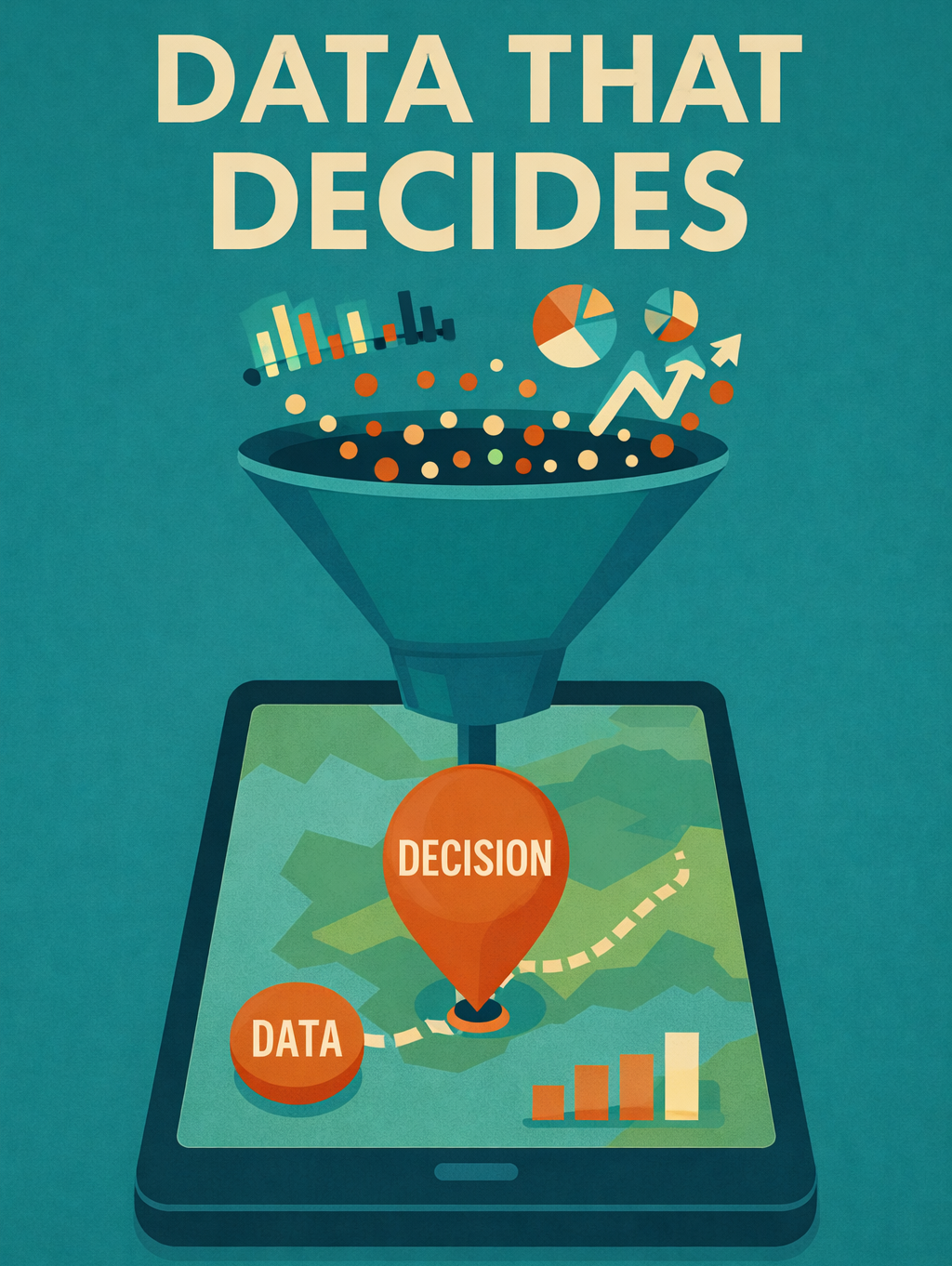
Data that Decides
Trusted numbers to repeatable calls: the operating system behind real outcomes.
I keep thinking about the meeting that looks like a win on paper.
The dashboards are clean. The definitions finally line up. Nobody’s arguing about whose report is “right.” You can feel the relief settle into the room like it’s earned. Then someone asks the question that always exposes the gap.
"So, what are we doing?”
And for a beat, nothing happens.
Not because the team’s incapable. Not because the data’s wrong. But because clarity, by itself, doesn’t produce motion. Clarity just removes excuses. It doesn’t assign authority. It doesn’t pick a trade-off. It doesn’t survive Tuesday.
That’s what the Data That Decides series ended up being about. Not analytics as a craft, but decision-making as an operating system. We didn’t need another sermon about being “data-driven.” We needed to name the mechanics that turn signal into action, and the human conditions that make those mechanics stick.
We started where most organizations live: dashboards that get admired, filtered, debated, and then politely ignored. The issue was never the visualization. It was the missing layer between “here’s what’s happening” and “here’s what we will do, by when, and who owns the call.” Decision Design was our first hard turn toward behavior: turning metrics into decision moments with owners, triggers, first actions, timeframes, and review loops. You can call it a canvas or a template, but the real move is simpler. You stop treating metrics like a scoreboard and start treating them like levers. A metric becomes useful when it has a defined response. If it moves here, we do this. If it crosses that line, we escalate. If it’s within tolerance, the local owner acts without asking permission. That’s the structure we laid down, and it’s deliberately practical because theory won’t hold under pressure.
Then we hit the part leaders don’t like to admit, because it’s not solved by more tooling. Even with a well-designed decision moment, a room can still refuse to step into it.
Decision Trust is the degree to which people are willing to act on a number without rebuilding it. That single sentence explains an uncomfortable amount of executive behavior. When trust is low, the first move is verification. “Are we sure?” “Can we rerun it?” “Let me have my team check it.” When trust is high, the first move is commitment. “Given this is our reality, what are we going to do?” Same dashboard. Different posture. Different speed. Different outcomes.
What mattered most in that chapter wasn’t the language. It was the diagnosis: trust leaks through technical seams (late, fragile, contradictory signals), semantic seams (definitions that shift under your feet), and social seams (data used as a weapon, surprises dropped into rooms, blame disguised as analysis). You can fix pipelines and still lose trust if the meeting behavior punishes people for surfacing uncertainty early. You can standardize definitions and still lose trust if leaders cherry-pick the slice that wins the moment. Decision Trust isn’t a policy. It’s a pattern, earned through repeated moments where the number holds and the room stays safe enough for people to act.
If we had stopped there, we would’ve described a lot of “mature” organizations that still frustrate everyone who works in them. Because trust removes the argument, but it doesn’t remove the drift.
That’s where Decision Direction came in, and it’s the chapter I think most leadership teams need to consider before they buy another platform. Direction happens when trusted data is paired with explicit decision rights, clear thresholds, and a cadence that forces choices. Another way to say it, bluntly: direction is clarity with authority attached. The data can be right and the room can still stall because nobody wants to own the risk of the call. So the conversation slides into hypotheses and follow-ups and “let’s keep an eye on it.” It looks like sophistication. It’s not. It’s avoidance with better charts.
Direction dies at the same three seams, but in a different way. The technical seam is about timeliness and reliability. If the signal arrives late or needs reconciliation every time, the organization treats it like history, not guidance. The semantic seam is about meaning. If “customer,” “on time,” “yield,” or “margin” can mean three things, you can’t build decision rights on top of it. The social seam is the hardest: who is authorized to decide, who carries the risk, and what incentives quietly reward staying vague. The key question we put on the table was the one that changes everything: what does this metric authorize us to do? Most companies have metrics. Fewer have authorizations. That gap is the space where drift lives.
And then we reached the step that separates a good quarter from a durable operating advantage.
The week shows up.
A metric swings hard and nobody knows if it’s noise or signal. A delivery date slips. An escalation lands at the worst possible time. A leader asks for one more cut “just to be sure,” and suddenly the room is loud again. The data might still be clean, but clarity is fragile when it’s held together by attention instead of habit.
Decision Cadence was the conclusion, and it’s also the beginning. Cadence is what makes direction repeatable. It’s not “more meetings.” It’s decision loops that fire reliably, at the right altitude, with clear triggers, inputs, owners, thresholds, and a decision log so the organization actually remembers what it chose. Without cadence, direction becomes personality. Great when the right people are in the room. Fragile when they’re not. Cadence is how decisions survive Tuesday.
What I like about this four-part arc is that it names the real constraint. Most organizations don’t stall because they lack insight. They stall because they lack follow-through. They have visibility, but they haven’t designed the system that converts visibility into action without drama.
This is where the series stops being about analytics and starts being about leadership.
If you want Data That Decides, you’re not really building reports. You’re building decision rights. You’re building decision memory. You’re building decision safety. And you’re building the discipline to prune and tune the system so it doesn’t collapse into bureaucracy.
That last point matters because cadence has a common failure mode. Teams overbuild. They design beautiful governance models and thick templates and ritual-heavy calendars. It launches with energy, and within weeks it becomes overhead instead of rhythm. The fix is to design like someone who has to run it on a bad week. Keep the daily loop brutally narrow. Keep the weekly loop decision-focused. Keep the monthly loop honest, with real tuning and real deletion. And log decisions like you mean it, because if it isn’t logged, it isn’t decided.
So what did we learn, really?
- We learned that dashboards are not decisions. They’re invitations.
- We learned that design creates the moment, but trust determines whether anyone steps into it.
- We learned that trust is not one vague thing. It breaks at technical, semantic, and social seams, and each seam needs a different repair.
- We learned that direction isn’t inspiration. It’s explicit authority paired with clear thresholds and real escalation paths.
- And, we learned that cadence is what makes direction durable enough to survive the week you’re actually having.
That’s the “what.” Here’s the “so what,” and it’s where the next series starts.
Once you have a decision system, the next challenge isn’t seeing reality. It’s governing change without slowing down. It’s scaling autonomy without creating drift. It’s making improvement survive the handoff so “better” becomes muscle, not a moment.
This is also where AI shows up as an accelerant, not a savior. Automation doesn’t tolerate fuzzy definitions. It doesn’t correct for political hesitation. It operationalizes whatever you actually have. If your decision rights are unclear, it amplifies the escalation storms. If your semantic layer is fragmented, it turns definition drift into automated misfires. If your social seam is broken, it turns mistrust into a permanent shadow system. In other words, the technology can be ready while the organization is not. That’s not pessimism. It’s the reality of socio-technical systems, and it’s why the work we just did matters.
So the next series will build on this foundation, but we’re going to move the camera slightly.
Less “how to get clean dashboards.” More “how to design an operating model that can absorb complexity.”
The working direction for the next run is simple: Decision Systems That Hold.
It will stay grounded in the same four themes, but push into the second-order problems leaders wrestle with in the real world:
We’ll get specific about decision boundaries, what must be centralized, what should be distributed, and what needs a clear escalation path so autonomy doesn’t turn into chaos. We’ll talk about decision memory as a strategic asset, because organizations that don’t remember end up re-litigating their way into fatigue. We’ll dig into governance that lives inside the workflow, not in committee calendars, because the best governance is invisible until the week gets messy. And we’ll tie it all back to execution, because direction that doesn’t survive handoffs isn’t direction. It’s theater.
If you want a practical bridge from this series into the next one, don’t start by reorganizing your analytics roadmap. Start by hardening one repeating decision.
Pick the decision that keeps showing up with new slides and the same discomfort. Forecast adjustments. Inventory reorders. Quality containment. Pricing exceptions. Credit holds. Project prioritization. Whatever hurts and recurs.
Then write down five things in plain language:
- What signal triggers the decision.
- What threshold forces action.
- Who decides inside normal range.
- When it escalates and to whom.
- How the decision will be logged and reviewed.
Run that for a month. Tune it once. Keep the log visible. You’ll learn more about your transformation maturity from that one loop than you will from a dozen maturity assessments.
And here’s the test I want to close on, because it’s the cleanest summary I know of what “data that decides” actually means:
When the number comes up, does your room move into trade-offs, or does it move into reruns?
If it’s reruns, you don’t need more dashboards. You need a stronger decision system.
If it’s trade-offs, you’re ready for the next level. Now the work is making it durable, scalable, and safe enough to move faster without breaking trust.
That’s where we’re going.
Sources
Davenport, T. H. (2006). Competing on analytics. Harvard Business Review, 84(1), 98–107, 134.
Edmondson, A. C. (1999). Psychological safety and learning behavior in work teams. Administrative Science Quarterly, 44(2), 350–383.
Kahneman, D. (2011). Thinking, fast and slow. Farrar, Straus and Giroux.
Weill, P., & Ross, J. W. (2004). IT governance: How top performers manage IT decision rights for superior results. Harvard Business School Press.