Across the Divide: The Quiet Work of Making Things Better
Innovation isn’t a spark. It’s the moment capability becomes curiosity.
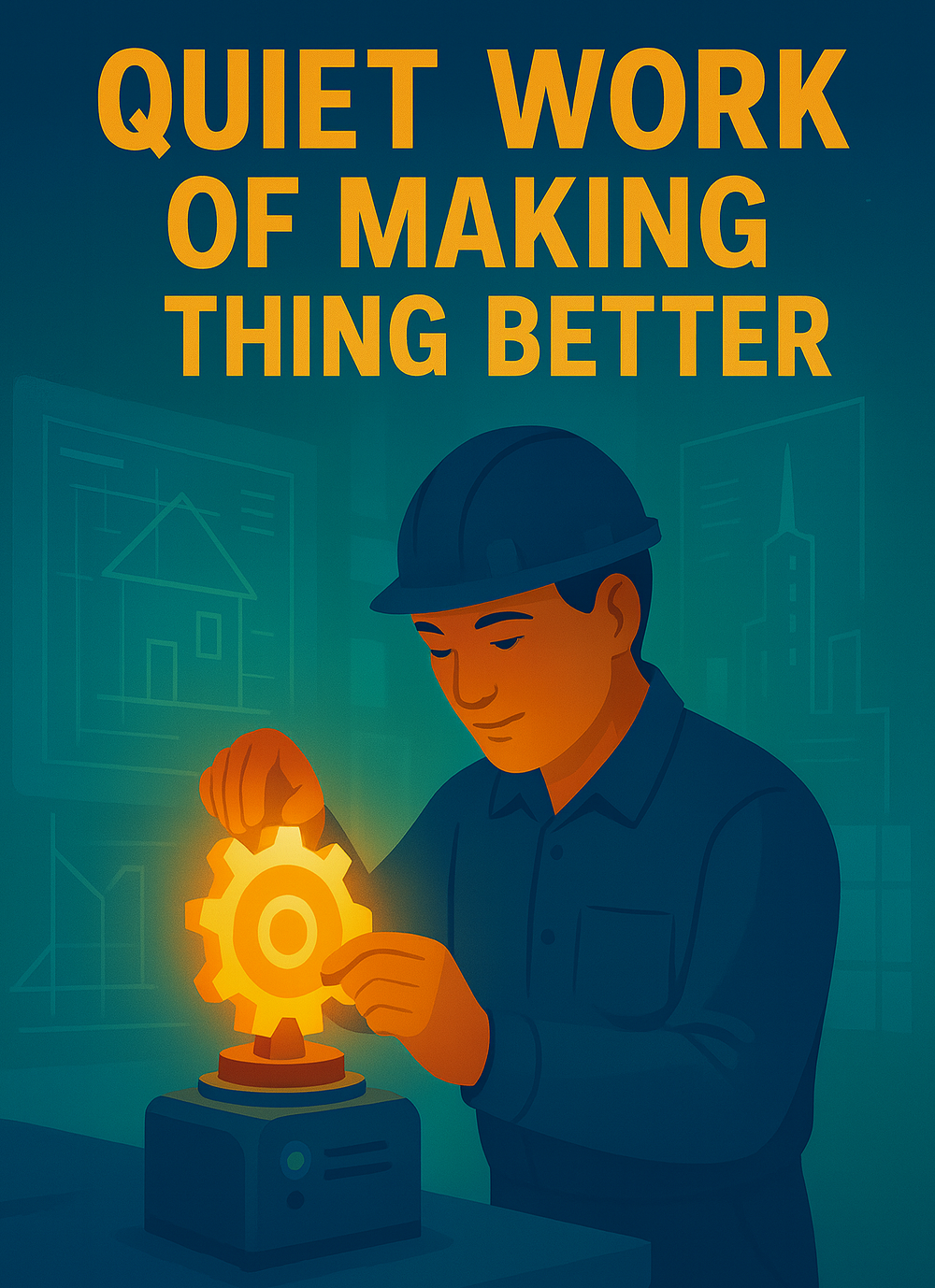
Some of the most innovative moments in manufacturing drift in so quietly that most people never see them for what they are.
They rarely occur in the rooms where organizations claim innovation happens. They don’t arrive during strategy sessions or steering committees. They appear in the seams of the day. A pause between cycles. The stillness after a line stabilizes. The quiet exchange between shifts when the air feels settled and the rhythm is steady. These are the moments where clarity slips in, usually unnoticed, and alters more about the plant’s trajectory than any formal initiative ever could.
Innovation on the floor doesn’t look like invention. It looks like awareness. A subtle adjustment by someone who knows the heartbeat of the line. A shift in how a startup sequence is paced. A note scribbled on a routine to remove friction no one had bothered to name. It’s practical and grounded, almost invisible, and deeply human.
It doesn’t demand attention; it reveals something.
And here is the truth most people outside manufacturing misunderstand: this industry doesn’t innovate in spite of its constraints. It innovates because of them.
The limits that outsiders assume are barriers become, for the people closest to the work, the clearest and most honest sources of insight.
Constraints sharpen judgment. They focus attention. They turn friction into information. They make patterns visible sooner and assumptions weaker faster. If you spend enough time inside the work, the boundaries stop feeling like obstacles and start feeling like contours. They show you where the system hesitates, where it strains, where it carries quiet inefficiencies that dashboards rarely capture in time. You stop searching for “permission” to innovate and begin noticing how the work itself keeps inviting you to.
These invitations don’t appear in chaotic environments. Chaos can mimic motion, but it cannot sustain change. There’s nothing steady enough to anchor an experiment to. No baseline to compare against. No place to stand where learning can accumulate. Innovation needs discipline first. It needs standards that hold. It needs routines and definitions that mean the same thing to the night shift as they do to the day shift. And once that structure settles into place; when the room moves with rhythm instead of scramble, you can feel the plant shift from defending the day to shaping it.
Predictability becomes a reference point.
Structure becomes safety.
Rhythm becomes space to think.
Innovation emerges naturally from that space.
This is the moment innovation starts to show itself for what it really is in operational environments: the natural extension of capability. Operators catch anomalies not because a system alerts them, but because the pattern is familiar enough that any disturbance feels like a tap on the shoulder. A line lead suggests reworking a staging step because the calm of the day finally reveals where the process carries unnecessary weight. A mechanic rewrites a troubleshooting guide not to challenge the standard, but because they understand the standard’s intention so deeply that its limitations become obvious.
Industry research supports what manufacturing has always known intuitively. McKinsey’s work on frontline innovation shows that nearly two-thirds of sustainable improvements originate at the point of work, not in centralized decision rooms. Deloitte’s manufacturing imperative underscores the same reality: when stability rises, creativity follows. And research in MIT Sloan’s studies of adaptive design notes that constraints often accelerate innovation by narrowing the field to what actually matters. Even Harvard Business Review has noted that “innovation rarely emerges from freeform creativity; it emerges from structured environments that make variation meaningful.”
Manufacturing didn’t need the research to operate this way. But it does help put the experience into language.
Once the structure is strong enough to support it, innovation becomes almost reflexive. The constraints that once felt restrictive become raw material. A cycle time that refuses to shift becomes an invitation to study the system more closely. A fluctuating measurement becomes a quiet question about variation. A bottleneck becomes a design challenge waiting to be interpreted. Every tension becomes a teacher. Every deviation becomes a hypothesis. And over time, these patterns shape how people think, how they communicate, how they interpret risk, and how they recognize opportunity.
Innovation stops being an event.
It becomes rhythm.
It becomes a steady, almost musical extension of capability.
There is a moment in every plant when this rhythm becomes visible. It reveals itself in the kinds of questions teams start asking. They move from “What went wrong?” to “What could go better?” They stop asking who made the mistake and start asking what the pattern is trying to show them. They stop waiting for someone else to diagnose the problem and begin forming their own interpretations based on lived intelligence. The work becomes a conversation rather than a sequence of instructions.
Leadership begins to change shape here as well. The leaders who succeed in this stage are not the ones who chase innovation. They’re the ones who cultivate the conditions where innovation becomes inevitable. They protect time for experimentation. They remove friction that has accumulated quietly over time. They ask questions that widen the field of possibility rather than narrow it. They listen more than they direct. They treat curiosity as a leadership tool, not a threat to control.
And they understand something I didn’t early in my own career: innovation is not something you initiate. It’s something you learn to recognize.
It took time on the floor to see this. I used to believe innovation lived in big ideas, strategic plans, and future-state frameworks. But the floor teaches you differently. Innovation grows where people know the work well enough to question it without destabilizing it. Where rhythm gives them the confidence to push on the edges. Where standards become something closer to shared language than mandated compliance. And once you see that shift, it’s impossible to unsee it.
This is also where technology enters the narrative—not as the protagonist, but as an amplifier. Automation accelerates what the process already encourages. AI scales insights only when the underlying data is trustworthy. New tools magnify behaviors that already exist. Plants that rely on technology alone struggle because they’re trying to accelerate a system they don’t yet understand.
Plants that invest in operational clarity first succeed because the technology has something stable to stand on.
You cannot automate your way into innovation.
You can only automate what you trust.
And once innovation gains momentum—not as a burst, but as a magnetic pull—you start to see the difference between movement and progress. Improvements begin stacking instead of colliding. Insights begin traveling instead of staying siloed. People begin anticipating rather than reacting. Teams begin moving with shared intuition instead of constant direction.
Momentum isn’t speed.
Momentum is direction with coherence.
And this coherence becomes the threshold to something larger. Innovation inside one cell can change a task. Innovation inside one line can change a shift. But innovation that connects across the plant, watching insights move across systems, behaviors aligning across functions, decisions informed by shared understanding—changes the enterprise. It marks the moment when a plant stops behaving like a set of independent operations and begins behaving like a learning organism.
Capability becomes coordination.
Coordination becomes intelligence.
Intelligence becomes anticipation.
That anticipation is the signal of what comes next.
Because once innovation stops living in isolated pockets and begins moving through the organization like current through wire. Consistently, predictably, and across boundaries; we see a new identity form.
A plant that can sense itself. A plant that can predict failure before it arrives. A plant that can adapt not just locally but systemically.
That is the chapter ahead.
The final piece of this arc will explore that horizon: how intelligence forms across processes, across teams, and across systems. How organizations begin to integrate insight rather than merely generate it. How the flow of innovation becomes the flow of foresight. How stability, creativity, and coordination create the foundation for the next era of manufacturing capability.
We began in the storm.
We built the structure.
We learned how innovation moves when the environment is ready for it.
And now we step into a different kind of landscape...the one where intelligence takes shape and the organization begins to see itself clearly.
Sources
Agile Business Consortium. (2024). Business agility works: A framework for adaptive organizations.
Deloitte. (2023). The smart manufacturing imperative: How leading plants realize value.
Harvard Business Review. (2021). Why constraints fuel creativity.
McKinsey & Company. (2024). Operating model shifts in modern manufacturing.
MIT Sloan Management Review. (2023). Adaptive design in complex environments.