Across the Divide: Scaling Better Without Breaking Trust
Visibility isn't the problem. Direction is. Here's how manufacturing teams scale improvement without breaking trust.
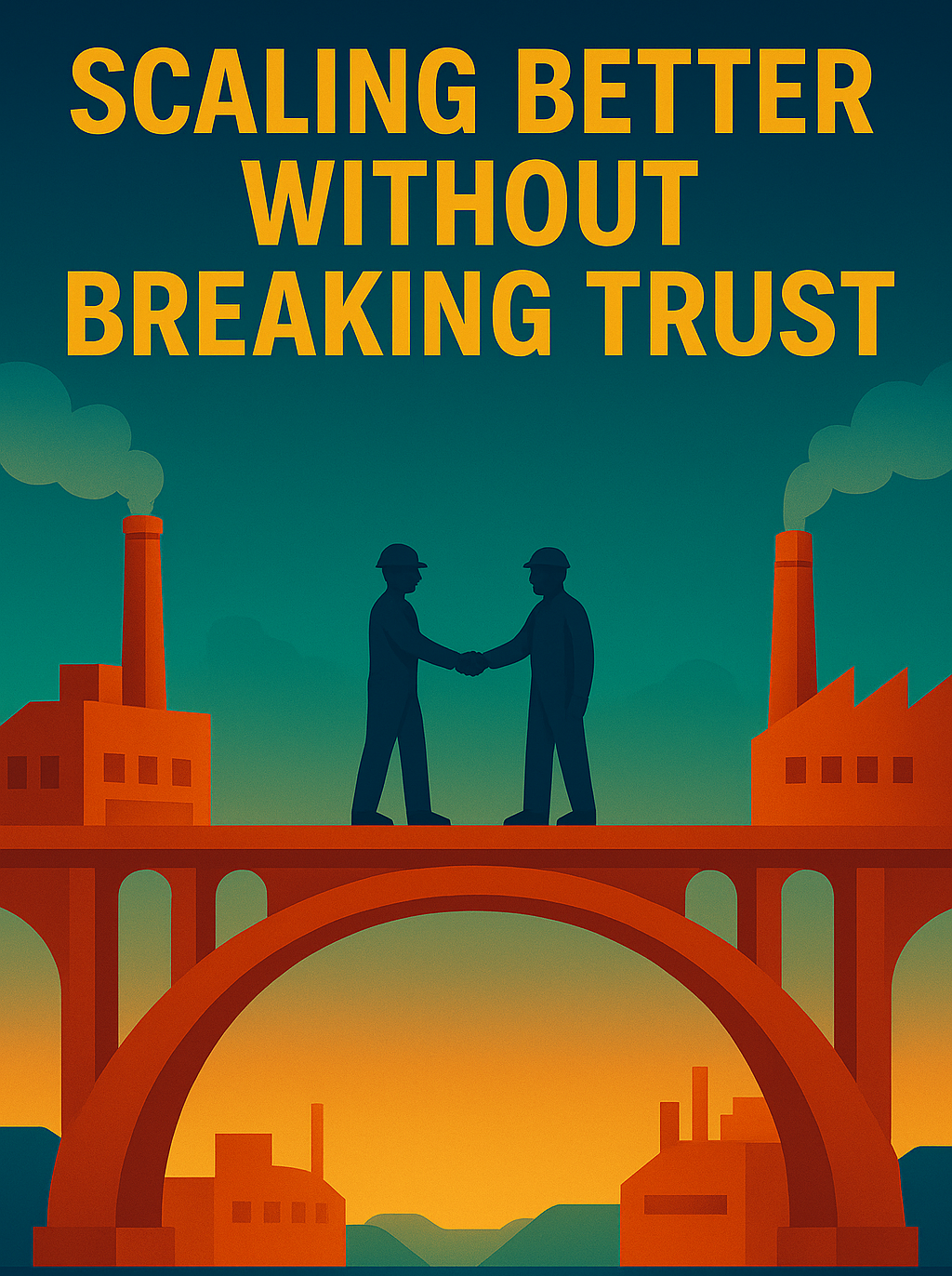
Most plants don’t do endings. They do handoffs.
I remember walking the floor a few weeks after a rough stretch. The kind where every day feels like it’s one sensor away from a bad headline. Then it went quiet. Not “nothing is happening” quiet. “Everything is holding” quiet. No huddles around a screen. No radio traffic with sharp edges. Just motion. Stable. Boring. Beautiful.
That’s usually when the real question shows up.
Not, “How do we survive the storm?”
Not, “How do we standardize the work?”
Not even, “How do we keep improving?”
It’s this: how does better move?
In manufacturing, better that stays local isn’t better. It’s luck with a short shelf life. A team finds a cleaner start-up sequence. An operator figures out how to avoid a recurring jam. A supervisor writes a smarter checklist. A planner stops trusting a report and starts running their own export because they’ve been burned too many times. All of it real. All of it valuable. And then someone takes PTO, the shift changes, the line gets rebalanced, or a system upgrade lands. The improvement goes with them.
That’s the gap between improvement and institutional learning. It’s also where digital transformation either becomes real, or becomes just another layer of reporting.
Here’s the cleanest way I know to say it: manufacturing transformation isn’t about adding tech. It’s about building a routing engine for learning.
Think about navigation apps for a second. The map isn’t the value. The loop is. Signals come in from real conditions, rules and thresholds turn those signals into guidance, and direction gets pushed back out fast enough for a human to act. Then it learns again. A healthy plant runs on the same pattern. The floor produces signals. The organization makes sense of them. Decisions get made with clear thresholds and clear owners. The learning propagates as the new default, not as a hero story told at the end of a shift.
The hard part is that scaling “better” introduces risk. Every time you propagate an improvement, you touch something people depend on. A sequence that keeps them safe. A quality check that protects customers. A definition that makes reports consistent. A screen they’ve finally learned to trust. Scale too slowly and you waste learning while paying for the same problems again and again. Scale too aggressively and you break belief, and the floor protects itself with workarounds.
So the real work is scaling improvement without breaking trust.
This is where I think in seams, because seams are where transformation lives. Not in slogans. Not in a roadmap. In the edges where things connect and often fail. There are three seams that decide whether better moves or dies: technical, semantic, and social.
The technical seam is the visible one. Sensors, historians, MES, ERP, quality, maintenance, integrations, reliability. If that seam is weak, you never see the truth fast enough to act. You live in lagging indicators and rear-view mirrors. The floor knows something’s happening, but the systems disagree, or agree too late. Micro-stops never trip alarms. Scanner retries get dismissed as noise. Rework queues appear like clockwork and only get attention after they become expensive.
But here’s the trap. A strong technical seam doesn’t automatically create action. It creates visibility. Most plants already have visibility. What they lack is direction.
That’s the semantic seam. Semantic sounds academic, but it’s brutally practical on the floor: what do we mean by what we measure? “Downtime” isn’t a number, it’s a classification fight waiting to happen. “Scrap” isn’t a metric, it’s a decision about ownership and root cause. “On-time” can mean three different things depending on whether you’re talking to production, shipping, or customer-facing teams. When the semantic seam is weak, you get the meeting everyone recognizes. A clean dashboard. Calm nods. Then drift. Which definition? Which report? Did the logic change? Is this a real spike or a tagging artifact?
Nothing kills propagation faster than ambiguous meaning. You can’t scale what you can’t define.
The fix isn’t more dashboards. It’s explicit thresholds paired with explicit decision rights. If X happens, we do Y. At this threshold, this role owns the call. If it crosses again, escalation changes. If it stays stable for N cycles, we treat it as the new default. Thresholds remove debate. They create permission. And permission is oxygen on the floor.
Then there’s the social seam, the one most programs underestimate until it bites them. Trust. Credibility. Safety. The belief that if I raise my hand and say “this is happening,” I’ll be heard, not punished. The belief that a process change won’t quietly make my job harder so someone else can claim a win upstairs. If the social seam is weak, the floor will still improve, because people always improvise to survive. They’ll just do it privately. In notebooks. In side conversations. In workarounds that keep the line moving but never become shared learning.
That’s not resistance. It’s a rational response to a system that doesn’t protect the people doing the work.
So when you ask “how does better move,” you’re really asking whether you have a loop that respects all three seams at once.
Here’s the loop in plain terms. It isn’t glamorous, but it works.
Start with friction as signal. Friction is data. The micro-stops that never trip alarms. The same hold that happens every Tuesday. The operator’s personal checklist that exists because the official one misses the step that prevents a defect. If your system requires an essay to capture friction, people will go back to sticky notes, and they’ll be right to. Make capture fast and structured. A few categories. A timestamp. A quick tag for “recurring.” A photo when it matters. Then make triage visible so the floor knows the signal landed somewhere real.
Next, convert signals into decisions, not just insights. This is where plants stall. They build analytics and wonder why behavior doesn’t change. The missing layer is decision design, the translation from “we see it” to “we know what to do.” Define thresholds and decision rights inside the operating rhythm, not as a one-time workshop. Daily, weekly, shift-based, whatever matches how the plant actually runs. When you get this right, meetings get shorter. Escalations get cleaner. Arguments fade because the rules are decided in advance.
Then propagate the learning into the places that shape behavior. Propagation isn’t an email and it isn’t a slide deck. It’s standard work updated at the point of work. Work instructions changed where hands and eyes are. System rules adjusted with change control that’s lightweight enough to be used, but real enough to protect safety and quality. Training embedded into the shift rhythm instead of treated like a one-time event. Release notes translated into “what’s different for you on Tuesday morning.” If you don’t have propagation, you don’t have transformation. You have pilots.
Finally, reinforce. A change isn’t real when it ships. It’s real when it holds. Day thirty. On a thin-staffed shift. Under pressure. Reinforcement means you watch adoption like you watch quality. You measure adherence. You measure exceptions. You treat exception handling as part of the system, not as failure.
That’s how you protect trust while scaling, because trust is the multiplier. Once it breaks, every number becomes negotiable again.
So this is what the series resolves to. Storms show you where you’re brittle. Standards show you how you hold steady. The quiet work shows you where improvement actually comes from. This final chapter is the commitment that completes the arc: we will not let learning stay local. We will build a routing engine that turns floor truth into shared direction, and we will do it without breaking the belief that makes the floor run in the first place.
Because in manufacturing, better isn’t a slogan. It’s a default you earn.
Let’s get real. Real talk. Real strategy. Real results in digital transformation.
Sources
Boston Consulting Group. (2020). Flipping the odds of digital transformation success.
Deloitte. (2022). The smart manufacturing imperative: How leading manufacturers realize value from digital transformation.
Kotter, J. P. (2012). Leading change. Harvard Business Review Press.
McKinsey & Company. (2024). The state of organizations 2024: Ten shifts transforming organizations.
Weill, P., & Ross, J. W. (2019). Designed for digital: How to architect your business for sustained success. MIT Press.
Womack, J. P., & Jones, D. T. (2003). Lean thinking: Banish waste and create wealth in your corporation (2nd ed.). Free Press.